
Industry Served: HealthTech
AI Triage: Intelligent Voice-Based Clinical Intake System
Modernizing Spine Care Triage with
Context-Aware AI
& Voice Interaction
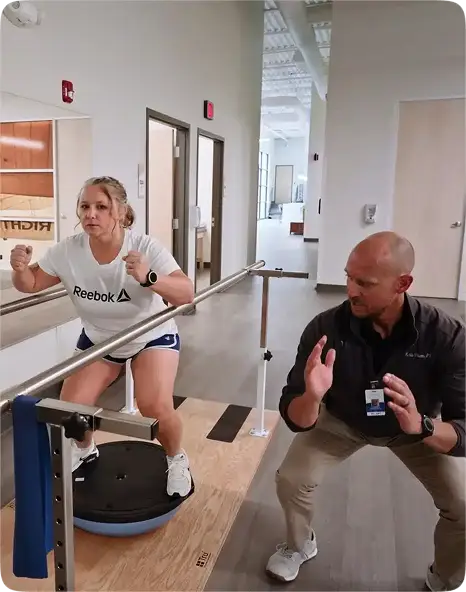
Vertrae is a leader in personalized spine care, offering non-surgical and surgical treatments for neck and back conditions. Led by Dr. Kamal Woods, Vertrae combines minimally invasive techniques with patient-centered care to improve recovery outcomes and quality of life.
As patient volume increased and digital expectations evolved, Vertrae needed to modernize its intake process. Traditional symptom collection was time-consuming, inconsistent, and reliant on manual coordination, often leading to unstructured information and delayed clinical decisions.
To address this, Vertrae implemented a scalable, AI-assisted triage system that conducts intelligent pre-consultation interviews, identifies red flags, and aligns with its spine-care methodology to improve efficiency and patient experience.
Discuss your projectProject Challenges and Needs
Manual & Time-Consuming Intake Process
New patient intake required staff-led symptom collection, slowing clinic operations.
Inconsistent Pre-Consultation Information
Patients often arrived without structured symptom summaries, limiting consultation efficiency.
Limited Clinical Pre-Screening
Identifying red flags or urgent cases before scheduling was difficult.
Desire for AI-Assisted Clinical Alignment
The clinic needed an AI system aligned with its specific treatment philosophy, not a generic chatbot.
Our Solution
We designed and developed AI Triage, a voice-enabled, web-based clinical intake assistant tailored specifically for Vertrae’s spine-care practice. The system transforms traditional intake into an intelligent, structured pre-consultation workflow that enhances both operational efficiency and patient experience.
The solution delivers:
Voice-based symptom capture without forms or manual typing
Dynamic follow-up questioning that adapts in real time
Triage logic aligned with Vertrae’s clinical standards
Red flag identification support for early risk awareness
Automated structured summaries for clinician review
Secure session logging and admin dashboard access
By embedding Vertrae’s treatment philosophy directly into the reasoning layer, AI Triage ensures every interaction aligns with the clinic’s standards of care. The result is a scalable digital intake system that reduces administrative burden, improves consultation readiness, and strengthens patient engagement from the very first interaction.
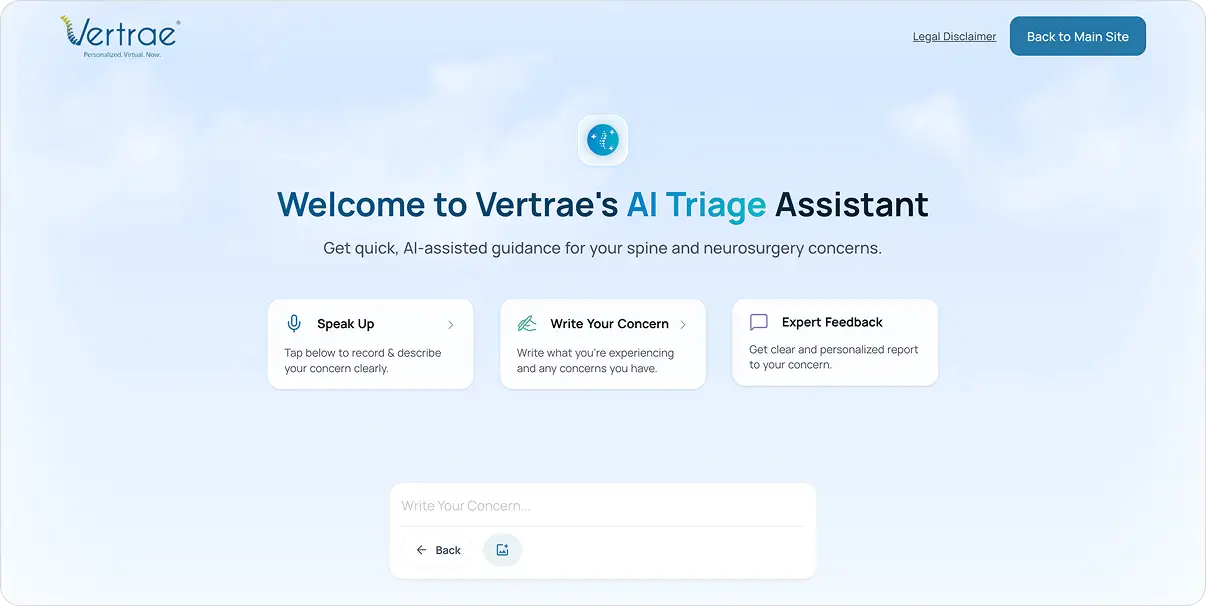
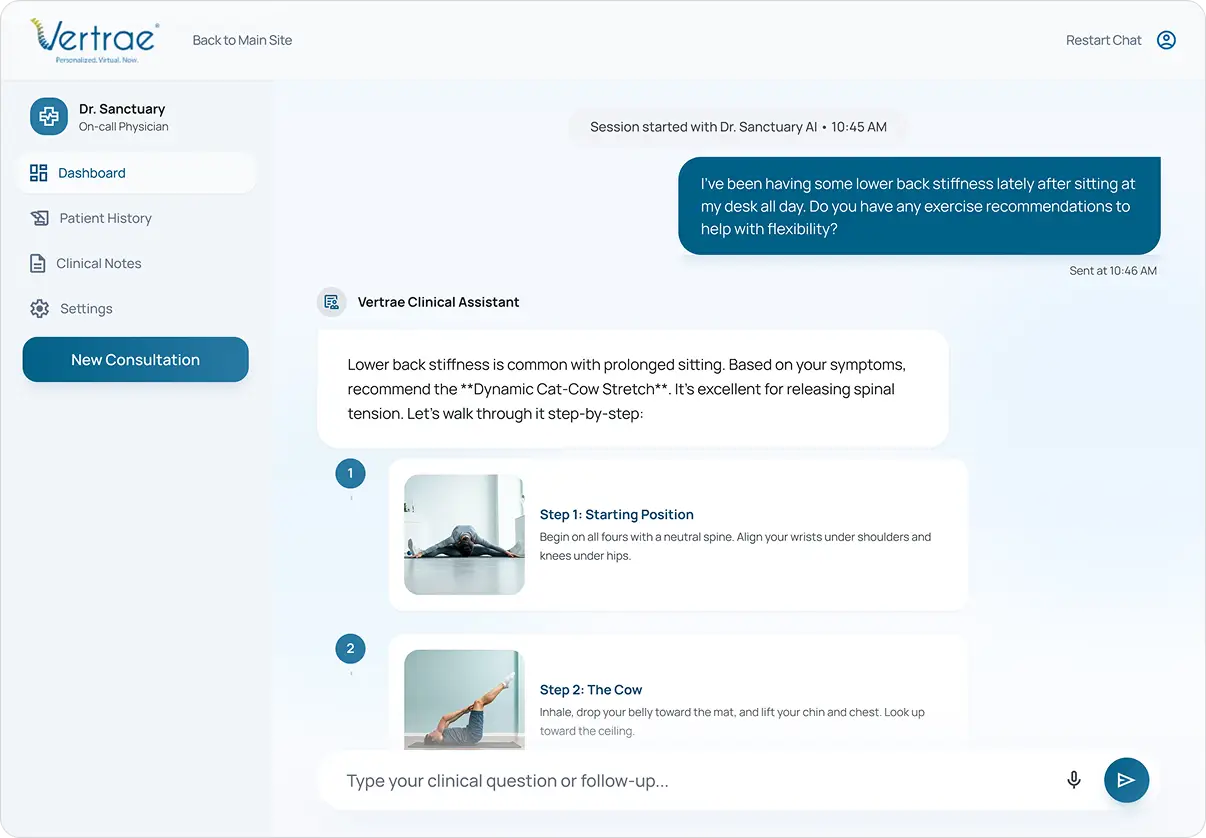
Interfaces We Developed

Patient Voice Triage Web Interface
A web-based, voice-enabled interface accessible via a dedicated subdomain. Patients can describe their symptoms naturally without filling out forms or typing responses.
The interface supports real-time conversational interaction and delivers structured summaries at the end of the session.

Admin Review Dashboard
A secure internal interface for Vertrae’s staff to review triage sessions. The dashboard provides access to session timestamps, reported symptoms, AI-generated summaries, and session IDs, enabling clinical oversight and continuous refinement.
Key Features & Capabilities
Voice-First Patient Interaction
Enables hands-free symptom reporting without forms or manual data entry.
Dynamic Conversational Flow
Adapts follow-up questions in real time based on patient responses.
Clinically Aligned Triage Logic
Applies Vertrae’s spine-care standards to guide structured evaluation.
Red Flag Identification Support
Highlights symptoms that may require urgent or in-person attention.
Automated Structured Summaries
Generates organized symptom overviews before consultation.
Secure Session Logging
Records interactions for administrative review and quality control.
Outcomes & Impact
40% Reduction in Intake Time
Automated interviews reduced manual symptom collection.
Better Risk Identification
Early flagging of urgent symptoms supports timely clinical intervention.
Reduced Administrative Burden
Staff time spent on initial symptom screening significantly decreased.
Improved Consultation Readiness
Clinicians receive structured summaries before appointments, enabling faster diagnosis discussions.
Enhanced Patient Experience
Voice-based interaction simplifies reporting for patients experiencing pain or mobility limitations.
Technologies Used to Develop the Solution
Frontend

React.js
Built the responsive, voice-enabled web triage interface.
Voice Processing

Browser Web Speech API
Enabled real-time voice-to-text symptom capture.
AI & Reasoning Layer

Conversational AI Engine
Powered adaptive questioning and symptom evaluation.

Context Injection Framework
Embedded Vertrae’s clinical standards into the reasoning process.
Backend

Node.js
Managed session orchestration, prompt structuring, and summary generation.
Scalability & Expansion

Modular Architecture
Designed to support future phone-based triage and structured workflow extensions.
Data & Security

Encrypted Session Storage
Secured patient transcripts and summaries.

Role-Based Access Control
Restricted admin access to triage records.
Here’s what the client has to say!
AI Triage has significantly enhanced how we approach patient intake. The system captures structured symptom information before the consultation begins, allowing our team to focus on meaningful clinical discussions rather than administrative screening. It aligns with our care philosophy while improving efficiency and patient experience.
Get in touch
Share a few details about what you're building, and we'll take it from there.