Industry Served: EdTech
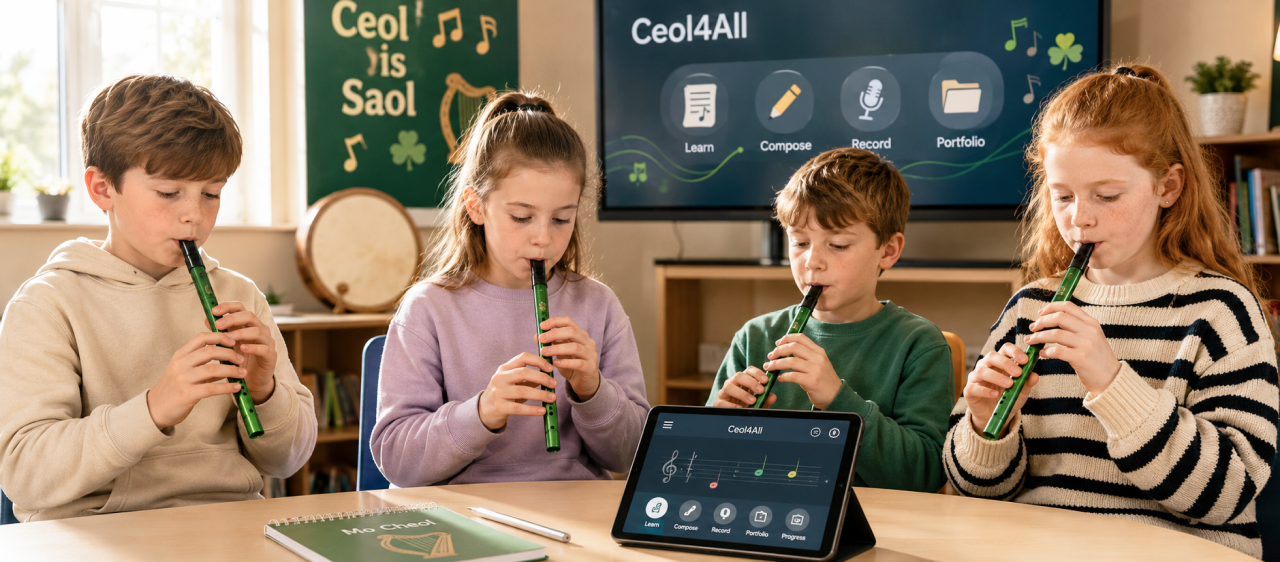
Ceol4All, A Digital Tin Whistle Platform for Irish Primary Schools
A Bilingual Web Platform Where Pupils Learn, Compose, Record and Build a Portfolio That Follows Them Through School
Music on the Timetable, Without a Music Specialist in the Room
Discuss your projectThe tin whistle is where most Irish primary pupils first meet an instrument. Teaching it usually falls to a class teacher who may not read music, working from photocopied sheets, a CD of backing tracks and whatever confidence they have. Pupils practise, play and move on. Nothing is kept, so there is no record of what a child could do in second class by the time they reach sixth.
Ceol4All set out to put the whole programme online. Lessons are structured for the class teacher to run as they are, in English or in Irish, with video instruction, practice audio at adjustable tempo, sheet music, listening activities, a composition workspace and a recording tool. Pupils keep everything they make.
We were the development partner for the platform, delivered across two phases. Phase 1 built the core: an Admin panel for the learning content and school onboarding, and a shared Teacher and Student interface covering lessons, composition, recording and the pupil portfolio. Phase 2 added bilingual English and Irish delivery, a structured response system with Spotify listening, a moderated class sharing gallery, a longitudinal portfolio held at school level, school licensing with free trials and online payment, an analytics module, and a public website for schools to find and trial the programme.
Project Challenges & Goals
Young Pupils, No Email Addresses
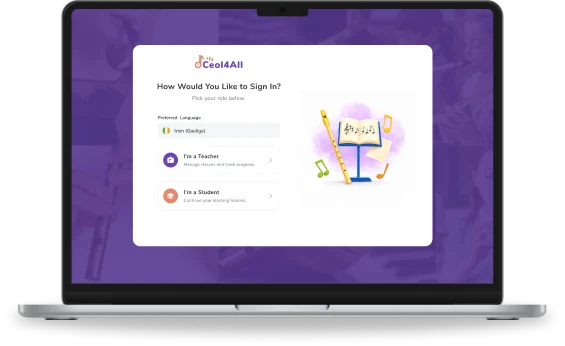
Children aged seven to twelve had to log in unaided, with no email accounts, and teachers had to be able to onboard a full class in minutes.
Notation Rules The System Must Enforce
Composition had to stay musically valid for beginners, holding each bar to the beats its time signature allows rather than letting a child fill a stave freely.
Everything Twice, In Two Languages
Interface, lesson content, resources and response questions all needed English and Irish versions, with the language a pupil sees controlled by their teacher.
Safeguarding Around Child Content
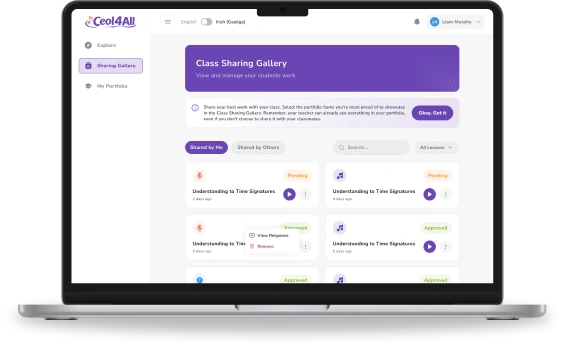
Image uploads, avatars and any peer visibility had to be designed so that nothing a child shares reaches classmates without teacher approval.
Work That Survives A Change Of Teacher
A portfolio tied to a teacher account resets every September, so pupil work had to belong to the school and follow the child up through the classes.
Selling To Schools, Not To Teachers
Trials and licences are started by individual teachers but paid for and held by the school, so identity had to hang off the Department roll number.
Our Solution
We built a role-based web platform for music teaching and learning, delivering:
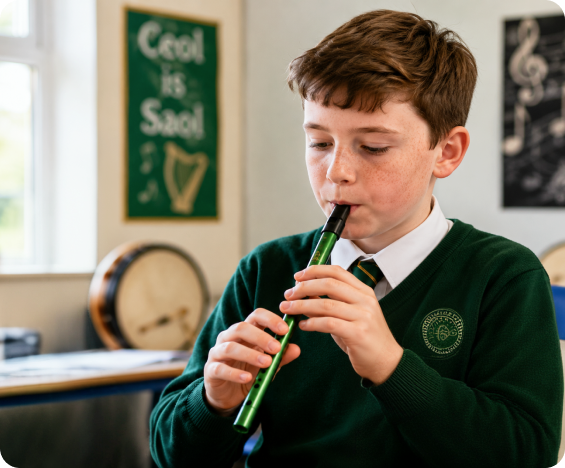
Teachers and pupils share one interface with role-based permissions, so a teacher sees exactly what the class sees plus the controls to manage it. Content is authored once in Admin and appears in the correct language, at the correct tempo, in the correct workspace configuration.
Interfaces We Developed
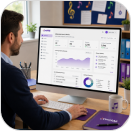
Admin Web Panel
The control layer for the Ceol4All team, covering the whole programme and the commercial side of the platform:
- A dashboard of stages, modules, lessons, schools, teachers, active licences and free trials
- School onboarding with roll number, licence type, licence status and trial expiry visible on the list
- Teacher accounts created with a generated password issued automatically by email
- Class, stage, module and lesson management, with lessons organised under their parent module
- Content management by module, lesson and section, authored separately in English and Irish
- Video links, master audio with tempo options, blend options, sheet music PDFs and instructional text
- Spotify track embedding and up to ten configurable response questions per lesson
- Composition bar count set per lesson at four, eight, sixteen, twenty-four or thirty-two bars
- Audio and video backing track configuration for recording activities
- Teacher resource PDFs uploaded against a stage, module and lesson, visible to teachers only
- Licence management, payment transaction logs and reporting with CSV or Excel export
- CMS pages, testimonials and FAQs, maintained in both languages
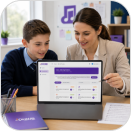
Teacher & Student Interface
One shared web interface for pupils and teachers, with each lesson covering five sections:
- Learning Together, the instructional video for the lesson, played in place
- Developing Musical Skills, practice audio with tempo and blend control, sheet music and instructions
- Creating, a stave workspace for placing notes and rests, playing back and saving to the portfolio
- Responding to Music, listening through embedded Spotify tracks and answering in text, audio or images
- Recording & Reflecting, microphone recording with or without a backing track, then listening back
- A portfolio of every composition, recording and response, with teacher feedback.
- Pupils choose what to submit to the class sharing gallery, and can withdraw it later
- Teachers add pupils, generate and reset PINs, and see indicators where work awaits review
- Teachers lock or unlock modules and lessons, and set the language of instruction for each class
- Teachers approve, reject or remove gallery submissions and leave badge or written feedback
- Trial status, remaining days and licence renewal prompts shown to teachers in place

Public Website
The front door for schools evaluating the programme, managed through the Admin CMS:
- Programme overview, curriculum detail and platform features for teachers and principals
- Teacher testimonials and FAQs, editable by the admin without a release
- Pricing, with free trial registration and licence purchase starting from the site
- Trial sign-ups flowing straight into the platform onboarding process
Key Features & Capabilities
Composition That Cannot Go Wrong
Notes and rests are dragged onto the stave within a system-defined time signature. An overfull bar is refused with a plain-language message rather than accepted and played back incorrectly.
One Audio File, Three Tempos
Phase 2 replaced separate uploads per tempo with dynamic playback speed, cutting the content team's upload work to a third and letting pupils slow a track down mid-practice.
English And Irish Throughout
Interface and content both switch. Teachers set the language for a class and decide whether pupils may switch it themselves, which suits Gaelscoileanna and English-medium schools from the same build.
A Portfolio That Follows The Child
Work is held against the school account, so it persists through a change of class, module or teacher. Pupils can archive or hide items but cannot delete them permanently.
Moderated Peer Sharing
Sharing is optional and always pending until the teacher approves it. Rejected work returns quietly to the pupil's private portfolio, and approved work can be removed from the gallery at any time.
Notation While Recording
Video backing tracks show the music on screen as the pupil plays, so nobody has to hold a PDF open beside the recorder. Audio backing is merged with the microphone into a single file.
Licensing On The Roll Number
Trials and paid licences attach to the school, identified by its roll number. A second teacher registering the same school joins the existing account instead of creating a duplicate.
Feedback In Two Taps
Teachers award preset badges such as Great Listening or Confident Performer, adding written comment only when they want to. Pupils are notified and see the feedback on the item itself.
Outcomes And Impact
Any Teacher Can Run It
Classroom
Video instruction, graded practice audio and teacher resources mean a class teacher without a music background can deliver the lesson as it stands.
Years Of Work, Kept
Progression
Compositions, recordings and responses build into a portfolio the school holds for the length of a pupil's time there, giving evidence of musical progress that paper never produced.
Trial To Licence In The Product
Commercial
A teacher signs up for a thirtyday trial from the public site and buys a school licence in the platform, with no sales step needed in between.
Technologies Used To Develop The Solution
Web Interfaces

Next.Js
Admin panel, the shared Teacher and Student interface, and the public website.
Backend
Node.Js
Shared APIs with role-based access for admin, teacher and pupil.
Database

PostgreSQL
Schools, licences, lesson content in both languages, and portfolio records.
Music Notation

VexFlow Stave Rendering
Stave, note and rest rendering with beat constraints enforced per bar.
Audio Engine

Web Audio API & MediaRecorder
Dynamic tempo playback, composition playback, in-browser microphone capture, and merging backing track with the recording.
Embedded Media

YouTube, Vimeo & Spotify
Lesson video with speed control and Spotify tracks for listening activities.
Payments

Stripe
School licence purchase and renewal, with transactions logged against the school.
Analytics

Google Analytics & Reporting Layer
Behaviour and conversion tracking alongside in-platform usage reports and exports.
Storage & Hosting

Cloud Object Storage With CDN
Audio, video, PDFs and pupil uploads served quickly to school networks.
Security

Encryption, RBAC & Transactional Email
School-level data separation, PIN handling for minors, and automated teacher credential delivery.
Here's What Our Client Has To Say
We came with a music programme and a lot of opinions about how children learn, and the team turned it into something teachers can pick up and use on a Monday morning. The composition tool behaves the way a music teacher would want it to, the Irish language work was handled properly rather than bolted on, and the licensing side means we can grow school by school. Two phases in, they still understand the classroom as well as the code.
Get in touch
Share a few details about what you're building, and we'll take it from there.